Your garage door works fine most of the day. Then, at the same time every afternoon (or morning), the garage door won’t close. A few hours later, everything’s back to normal. What’s going on?
You might suspect a failing opener, a wiring problem, or bad safety sensors. Before you replace anything, there’s another possibility worth checking.
The sun.
It sounds unlikely, but direct sunlight can interfere with the photo-eye safety sensors that keep your garage door from closing on a person, pet, or object. Here in Minnesota, the direction your garage faces, the time of year, and which side of the door each sensor is mounted on can all make a difference.
Table of Contents
How Can Sunlight Stop a Garage Door From Closing?
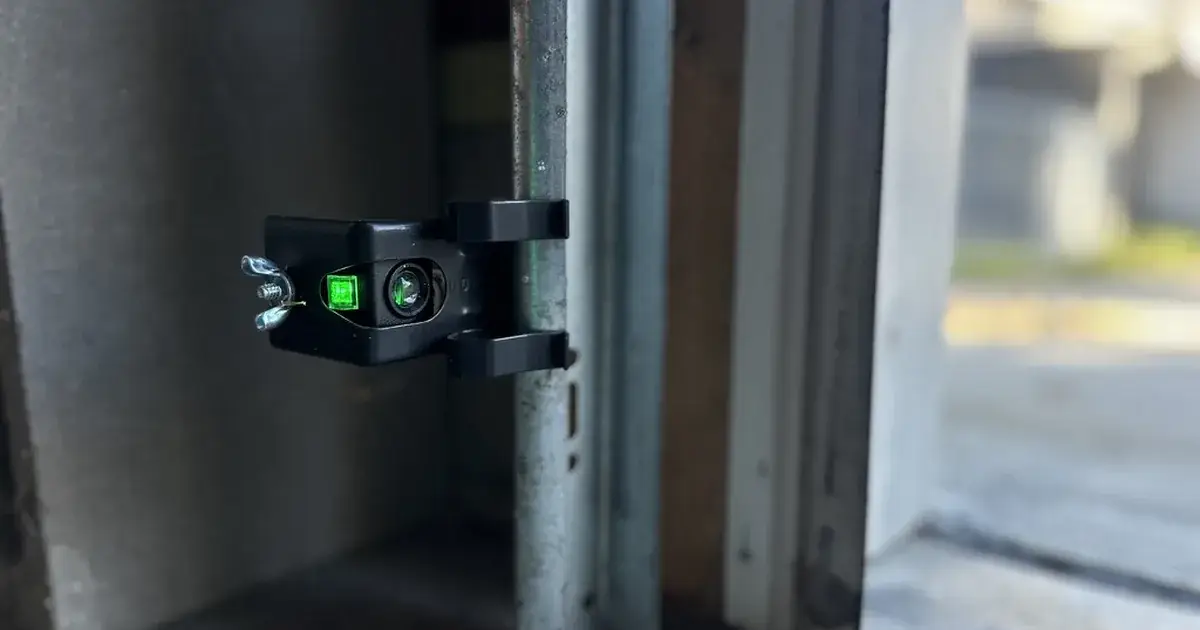
Most modern residential openers use two photo-eye safety sensors mounted near the bottom of the door tracks. One sends an invisible infrared beam across the opening, and the other receives it.
When something interrupts that beam, the opener won’t close the door, or it reverses the door if it’s already coming down. It’s an important safety feature. The catch is that the receiving sensor can sometimes have trouble telling its infrared signal apart from intense sunlight shining into its lens.
When that happens, the opener acts as though something is blocking the doorway. You press the remote, and the door starts down, then reverses. Or it refuses to move at all. On many openers, the light bulbs flash about 10 times, which is the opener’s way of saying the sensors can’t see each other.
Nothing is in the way and nothing looks broken, yet the door won’t cooperate.
Why Your Garage’s Direction Matters
The direction your garage faces determines when low-angle sunlight can reach the doorway. For homeowners in Hastings, Cottage Grove, Woodbury, and the rest of the South & East Metro, here’s when each orientation is most likely to see trouble:
| Garage Faces | Potential Trouble Times | Seasonal Considerations |
|---|---|---|
| West | Afternoon and evening | The sun’s angle shifts through the year, so problems may come and go by season |
| East | Morning | Same pattern as west-facing, in reverse |
| South | Late morning to early afternoon | Most likely in winter, when the sun stays low |
| North | Just after sunrise or before sunset | Mainly late spring and summer |
West-facing garages are the classic case: the door won’t close when you get home from work, then it works fine after dark.
Why the Sensor’s Position Matters Even More
Here’s what most people miss: the sensors face across the doorway, not out toward the driveway. Sunlight coming straight into the garage hits the lens edge-on and usually causes no trouble.
The problem shows up when a low sun shines in at an angle from the side the receiving sensor is facing. So the direction your garage faces only tells part of the story. Whether sunlight actually reaches the lens depends on which side of the opening holds the receiver, and on what surrounds it: trees, neighboring houses, roof overhangs, the track itself, and even sunlight reflecting off a bright driveway or fresh snow.
That’s why two neighbors with garages facing the same direction can have completely different experiences. It’s also why a problem can show up for a few weeks and then seem to fix itself as the sun’s angle shifts.
The Green Sensor Is the One to Watch
On most modern Chamberlain and LiftMaster openers, the two sensors have different indicator colors:
- Amber light: the sending sensor, which transmits the beam.
- Green light: the receiving sensor, which detects it.
The green receiver is the one affected by sunlight. When the sensors are aligned and working, its light should stay steadily lit. If it flickers or goes out when sunlight hits it, that’s an important clue.
Don’t assume sunlight is the culprit just because your garage faces west, though. Misalignment, damaged wiring, dirty lenses, and loose brackets can all cause the same symptoms.
A Simple Way to Check for Sunlight Interference
If your door refuses to close at a particular time of day, try this:
- With the doorway clear and the opener idle, find the receiving sensor (the green light) near the bottom of the track.
- Look for sunlight shining into its lens.
- Without touching or moving the sensor, shade the lens with your hand or a piece of cardboard. Be careful not to block the beam across the doorway.
- Watch the green light.
If it goes from flickering or off to steadily lit when you block the sun, that’s a strong sign sunlight is interfering with the receiver. It doesn’t mean the sensor needs replacing. It means the installation deserves a closer look.
Need to close the door right now? On many Chamberlain and LiftMaster openers, when the safety sensors are the problem, you can press and hold the wall button until the door is fully closed. This isn’t a fix for every opener problem. Keep a clear view of the doorway the entire time, and let go immediately if anything moves into its path.
Never disconnect, bypass, or disable the safety sensors to make the door close. They’re there to protect people, pets, and property.
Why Sunlight Isn’t Always the Whole Problem
Sunlight is often the trigger, but not the only factor.
A slightly misaligned receiver might pick up enough signal to work under normal conditions. Add direct sun, and it can’t hold on. A dirty lens weakens the signal further, and loose brackets or damaged wiring add to the problem.
That’s why a proper diagnosis covers sensor alignment, mounting, lens condition, wiring, and operation, not just the direction the garage faces.
How Sunlight Interference Gets Fixed
Once sunlight is confirmed, the fix is usually simple:
- Reposition the receiving sensor. On compatible systems, switching the sending and receiving sensors can put the receiver on the shaded side of the opening.
- Add a sun shield. A properly installed shield over the receiver blocks direct sun. It must not obstruct the infrared beam or interfere with the door’s operation.
- Correct the underlying issues. Realign, clean, and secure the sensors so they have a strong signal to start with.
In most cases, none of this requires a new opener. It takes a careful look at the sensors, which is part of every opener repair visit.
Don’t Replace the Opener Before Understanding the Problem
Intermittent problems are frustrating, especially when everything works fine by the time a technician shows up. But the timing of the failure tells us a lot.
Does the door refuse to close only at a certain time of day? Only on sunny days? Does the problem disappear once the sun moves? Those details narrow the diagnosis considerably.
At Spiral Garage Door, we believe understanding why something isn’t working matters just as much as getting it working again. We inspect the complete system, identify deficiencies, and explain what needs attention. Replacing parts without finding the cause isn’t much of a repair strategy.
Garage Door Won’t Close? Give Us a Call.
Spiral Garage Door is based in Hastings, Minnesota, serving homeowners throughout the South & East Metro and nearby western Wisconsin communities. If your door closes inconsistently, reverses unexpectedly, or seems to have a mind of its own at certain times of day, we’ll find out why.
No trip fees anywhere we serve, and free estimates on repairs. Or book a free tune-up, and we’ll test your sensors along with the rest of your door.
Local Roots. Personal Service.