
Resource Guide
Garage Door Rollers
A complete guide to garage door rollers, including roller types, wheel materials, bearings, cycle life, common failure modes, inspection, maintenance, and replacement considerations.
Noisy or wobbly rollers?Call for an inspection and roller replacement. Free estimates, no trip charge.
(612) 314-5990Overview
What Are Garage Door Rollers?
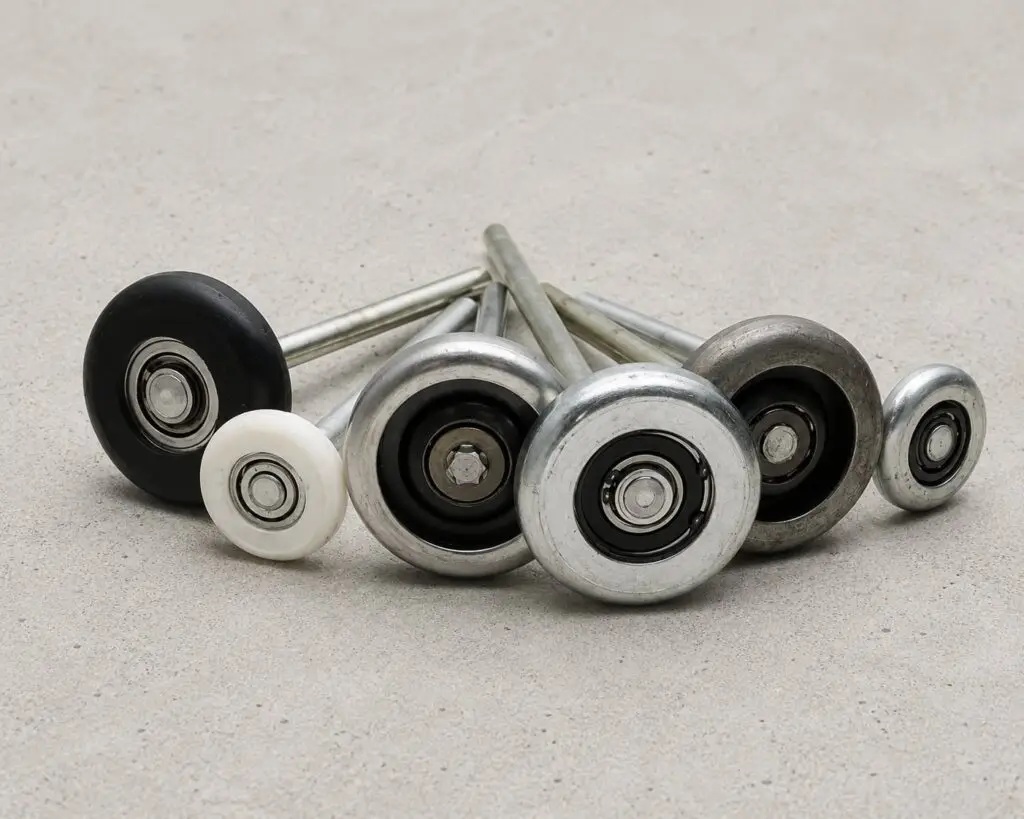
Garage door rollers are the wheels that allow a sectional garage door to travel smoothly along the vertical and horizontal tracks. Although they are relatively small components, every opening and closing cycle depends on them. A typical residential garage door may weigh between 100 and 400 pounds, while commercial doors can weigh several thousand pounds. Rollers help guide that weight through the track while minimizing friction and supporting stable movement.
Despite their name, rollers do more than simply “roll.” Each roller consists of a wheel attached to a steel stem that passes through a hinge or roller carrier. As the door moves, the wheel rotates within the track while the stem pivots slightly to accommodate the changing angle between door sections. This combination of rolling and pivoting allows the door to transition smoothly from the vertical tracks into the horizontal tracks above the garage.
Because rollers move every time the door operates, they are considered wear components. Bearings eventually wear, wheel materials fatigue, stems loosen, and lubrication breaks down over time. A single worn roller can increase noise, place additional stress on the opener, and accelerate wear on hinges and tracks.
Understanding how rollers are constructed, the materials used, and the conditions that affect their service life helps explain why they eventually require inspection and replacement.
Good to KnowA standard 7-foot residential garage door uses ten rollers. An 8-foot door typically uses twelve. Commercial doors may use significantly more depending on door height and configuration.
How Rollers Work
How Garage Door Rollers Work
At first glance, garage door rollers appear simple. In reality, they perform several jobs simultaneously.
As the garage door opens, torsion or extension springs offset most of the door’s weight. The rollers are not responsible for lifting the door. Instead, they guide the balanced door through the track while supporting side loads and maintaining alignment.
Each roller consists of two primary components:
- A wheel that rides inside the track
- A steel stem secured within the door hinge or roller carrier
When the door is closed, rollers travel vertically. As the top section approaches the curved portion of the track, the stems rotate within the hinges while the wheels follow the radius into the horizontal tracks. This continuous change in direction occurs every time the door cycles.
The roller experiences several forces simultaneously:
- Radial loads from the weight of the balanced door
- Side loads generated during track transitions
- Rotational forces within the wheel bearings
- Minor angular movement through the hinge
Because these forces repeat thousands of times over many years, even small amounts of bearing wear eventually become noticeable.
The Importance of Bearings
The wheel rotates around bearings located inside the roller. Better bearings reduce friction, distribute loads more evenly, and typically provide longer service life.
As bearings wear, the wheel develops additional play. Instead of rolling smoothly, it may wobble within the track. Increased vibration often follows, along with additional wear on hinges, tracks, and door hardware.
Roller Types
Types Of Garage Door Rollers
Garage door rollers are available in several designs. The correct roller depends on the door’s weight, track configuration, operating frequency, and application.
Stem Rollers
The most common residential roller consists of a wheel mounted on a fixed steel stem. The stem passes through the hinge and remains stationary while the wheel rotates around it.
This design is simple, durable, and suitable for most sectional garage doors.
Short Stem Rollers
Short stem rollers provide additional clearance in certain track configurations or low-headroom applications.
These are typically selected by the door manufacturer or installer based on available space.
Long Stem Rollers
Long stem rollers allow additional adjustment between the door and the track.
They are often found in commercial doors, heavier doors, or specialized hardware configurations where increased adjustment is required.
Commercial Rollers
Commercial sectional doors frequently use larger, heavier-duty rollers designed for increased loads and higher cycle counts.
Features may include:
- Larger diameter stems
- Hardened steel components
- Heavy-duty bearings
- Steel wheels
- Increased load capacity
Many commercial facilities also specify high-cycle rollers designed for continuous daily operation.
Specialty Rollers
Certain applications require specialized roller designs.
Examples include:
- Car wash doors
These systems often require rollers specifically engineered for unique track geometries.
Materials
Roller Materials
The wheel material plays a significant role in noise, durability, maintenance requirements, and operating characteristics.
No single material is ideal for every application.
Plastic Rollers
Basic plastic rollers are commonly installed on lower-cost residential doors.
Advantages
- Low manufacturing cost
- Quiet initial operation
- Corrosion resistant
Disadvantages
- Limited service life
- Greater susceptibility to cracking
- Faster wear under heavier loads
- Often manufactured without ball bearings
Plastic rollers generally provide the shortest lifespan of common roller materials.
Steel Rollers
Steel rollers have been used for decades in both residential and commercial applications.
Advantages
- High strength
- Excellent load capacity
- Resistant to wheel deformation
- Suitable for heavy doors
Disadvantages
- Increased operating noise
- Potential for corrosion
- Require periodic lubrication
- Can transmit vibration into the building structure
Steel remains the preferred material for many industrial and commercial applications where durability outweighs noise concerns.
Nylon Rollers
Nylon rollers have become increasingly common on residential doors because they operate much more quietly than steel.
Advantages
- Reduced noise
- Smooth operation
- Corrosion resistant wheel
- Lower vibration
- Minimal wheel lubrication requirements
Disadvantages
- Wheel material can fatigue over time
- Performance depends heavily on bearing quality
- Less suitable for some heavy commercial applications
It is important to recognize that “nylon roller” describes only the wheel material. The stem and bearings remain steel.
Reinforced Polymer Rollers
Some manufacturers use engineered polymers or reinforced nylon formulations intended to improve durability.
These materials may provide:
- Increased impact resistance
- Reduced wear
- Improved dimensional stability
- Better long-term performance under repeated cycling
Performance varies by manufacturer and design.
Material Comparison
Material
Noise
Strength
Corrosion Resistance
Typical Use
Plastic
Very Quiet
Low
Excellent
Economy residential
Nylon
Quiet
Moderate
Excellent
Premium residential
Steel
Loudest
Highest
Moderate
Commercial and heavy-duty applications
The wheel material represents only one part of the roller’s overall quality. Bearing design often has an even greater influence on long-term performance.
Common MisconceptionA nylon wheel does not automatically mean a premium roller. Two nylon rollers may look nearly identical while using completely different bearing designs and expected service lives.
Bearings
Bearings And Bearing Counts
The bearing assembly is the heart of a garage door roller. While the wheel contacts the track, the bearings determine how smoothly that wheel rotates under load. In many cases, two rollers made from the same wheel material perform very differently because of the bearings inside.
Rollers are commonly marketed by their bearing count. You may see products advertised as “7-ball,” “10-ball,” or “13-ball” rollers. This refers to the number of steel balls contained within the bearing assembly.
In general, additional bearing balls distribute loads across more contact points. This can reduce friction, improve smoothness, and extend service life when combined with quality materials and proper manufacturing. Bearing count alone, however, does not determine quality. Bearing material, heat treatment, lubrication, seals, and manufacturing tolerances all contribute to long-term performance.
Bearingless Rollers
Some economy rollers use no ball bearings at all. Instead, the wheel rotates directly on the steel stem.
Advantages
- Lower cost
- Simpler construction
- Fewer moving parts
Disadvantages
- Increased friction
- Faster wear
- More operating noise over time
- Shorter service life
Bearingless rollers are generally found on builder-grade residential doors and are not intended for high-cycle applications.
Ball Bearing Rollers
Ball bearing rollers reduce friction by allowing hardened steel balls to rotate between inner and outer races.
Common configurations include:
7-Ball BearingsA common entry-level bearing design suitable for many residential doors with average daily use.
10-Ball BearingsOften considered a mid-grade option. The additional bearing surfaces generally provide smoother operation and improved durability compared to economy rollers.
11- and 13-Ball BearingsFrequently found in premium residential and commercial rollers. These designs are often selected for heavier doors, higher daily cycle counts, or applications where long service life is a priority.
Sealed vs. Open Bearings
Some rollers use open bearing designs, while others incorporate shields or seals to help retain lubricant and reduce contamination from dust and debris.
Sealed bearings typically require less maintenance and may provide longer service life in dirty or humid environments. Open bearings can perform well when properly lubricated and maintained but are generally more susceptible to contamination.
Inspection TipA noisy roller is not always the result of a worn wheel. In many cases, the wheel is still in good condition while the bearings inside have begun to wear or lose lubrication.
Stem Sizes
Roller Stem Lengths and Sizes
While the wheel receives most of the attention, the stem is equally important. The stem connects the roller to the hinge or end stile and positions the wheel correctly within the track. Proper stem length helps maintain the correct door-to-track spacing throughout the door’s travel.
Residential garage doors typically use 4-inch short stem rollers. Commercial sectional doors, however, may use longer stems depending on the door construction and hardware configuration.
Common Roller Stem Lengths
Garage door rollers are commonly available in four standard stem lengths:
Stem Length
Industry Term
Typical Applications
4″
Short Stem
Most residential doors and commercial doors with a single end stile
7″
Long Stem
Double end stile construction
9″
Extra Long Stem
Triple end stile construction
11″
Extra Extra Long Stem
Heavy-duty and specialty commercial applications
Why Different Stem Lengths Exist
Unlike most residential doors, many commercial sectional doors use multiple end stiles at the edge of each section to increase strength and support heavier loads.
Each additional end stile spaces the roller farther from the edge of the door. Longer roller stems are used to position the wheel correctly within the track while accommodating the added hardware.
As a general rule:
- Short stem (4″) rollers are used with single end stiles.
- Long stem (7″) rollers are used with double end stiles.
- Extra long (9″) rollers are used with triple end stiles.
- Extra extra long (11″) rollers are typically reserved for heavy-duty commercial and specialty door systems.
The correct stem length depends on the door manufacturer, hardware design, and track configuration.
Wheel Diameter
Roller stem length should not be confused with wheel diameter.
Most residential sectional doors use 2-inch rollers, while many commercial doors use 3-inch rollers to better distribute loads and accommodate heavier hardware.
Both the stem length and wheel diameter should match the door manufacturer’s specifications.
Cycle Life
Understanding Cycle Life
Every garage door roller has a finite service life.
Rather than measuring life in years, manufacturers often discuss durability in cycles. One cycle consists of one complete opening and one complete closing of the garage door.
For example:
- Open the door in the morning.
- Close it after leaving.
- Open it when returning home.
- Close it for the evening.
That equals two cycles.
Why Cycle Ratings Matter
Rollers experience repeated loading every time the door operates.
Over thousands of cycles:
- Bearings wear.
- Lubricants degrade.
- Wheels fatigue.
- Stems develop wear.
- Corrosion may begin.
Cycle ratings provide a general indication of expected durability under controlled testing conditions.
Actual service life depends on many variables beyond the laboratory.
Estimated Service Life
Daily Cycles
Approximate Annual Cycles
10,000-Cycle Roller
Est. Life
2 per day
730 / yr
~13.7 yrs
4 per day
1,460 / yr
~6.8 yrs
6 per day
2,190 / yr
~4.6 yrs
8 per day
2,920 / yr
~3.4 yrs
10 per day
3,650 / yr
~2.7 yrs
ImportantCycle ratings are estimates based on controlled testing. Real-world service life varies depending on door weight, maintenance, environment, hardware quality, and operating conditions.
Service Life
What Affects Roller Life?
No two garage doors accumulate wear at the same rate.
Several factors influence how long rollers remain in good operating condition.
Daily Usage
Higher cycle counts accelerate bearing wear.
A vacation home may accumulate only a few hundred cycles each year, while an active household or commercial facility may operate the door thousands of times annually.
Door Weight
Heavier doors place greater loads on the roller bearings.
Wood overlay doors, oversized doors, insulated commercial doors, and high-wind doors generally increase roller loading compared to lighter residential doors.
Spring Balance
A properly balanced door places relatively modest loads on the rollers.
When springs weaken or become improperly adjusted, additional weight is transferred throughout the system. Rollers, hinges, tracks, and openers all experience increased stress.
Track Alignment
Bent or misaligned tracks can create side loading that forces rollers against one side of the track.
Instead of rolling freely, the wheel may scrub or bind, accelerating wear.
Lubrication
Proper lubrication reduces friction within applicable bearing designs.
Neglecting lubrication can shorten bearing life, while excessive lubrication may attract dust and debris.
Corrosion
Moisture, road salt, humidity, and certain industrial environments promote corrosion.
Rust can damage bearings, stems, and wheel assemblies over time.
Installation Quality
Incorrect hinge placement, improper track spacing, or damaged hardware can all reduce roller life.
Even premium rollers cannot compensate for poor installation.
Inspection
Inspection and Preventive Maintenance
Routine inspections often identify worn rollers before they become a larger problem.
Many roller failures develop gradually. Early warning signs usually appear well before complete failure.
Visual Inspection
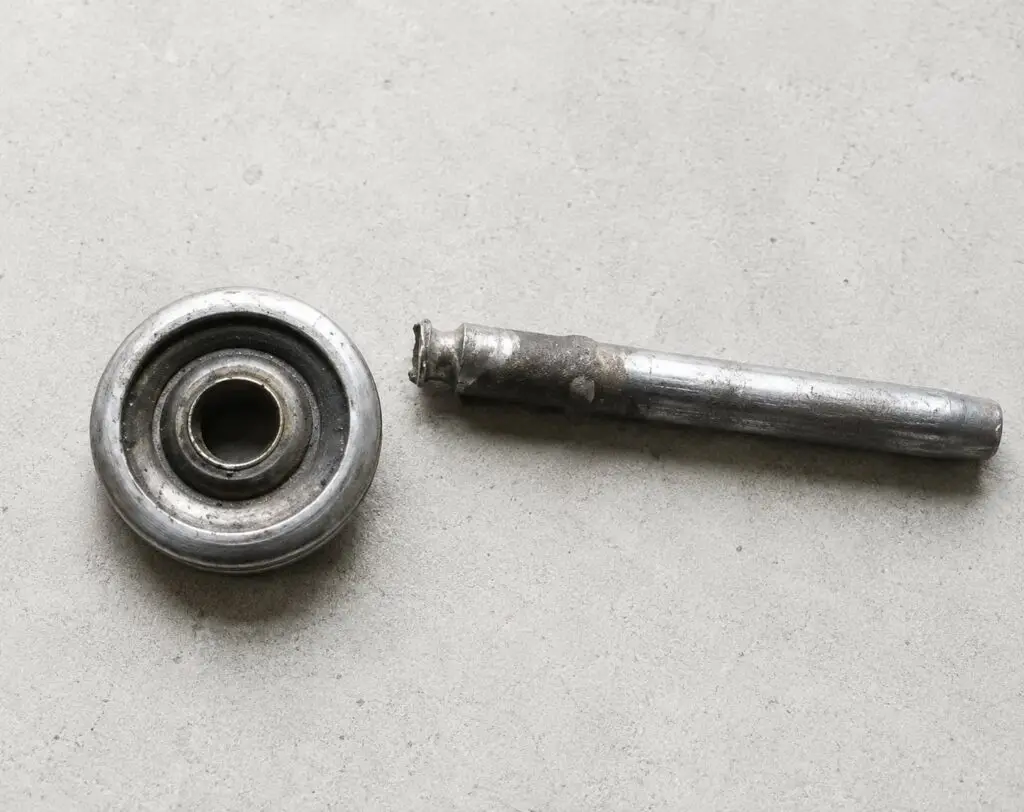
Look for:
- Cracked wheels
- Broken wheel edges
- Missing bearing retainers
- Rust
- Flat spots
- Bent stems
- Loose hinges
Operational Inspection
Operate the door while observing each roller.
Watch for:
- Excessive wobble
- Jerky movement
- Wheel vibration
- Rollers that hesitate
- Rollers that slide instead of rotate
The door should move smoothly through the curved track transition without noticeable binding.
Noise Inspection
Listen for changes.
Common sounds include:
- Grinding
- Squeaking
- Clicking
- Rumbling
- Metallic scraping
Noise alone does not identify the exact problem, but it often indicates that additional inspection is warranted.
Lubrication
Most manufacturers recommend periodic lubrication of steel bearings and hinge pivot points using products intended for garage door hardware.
Avoid heavy grease inside the tracks.
The tracks should remain clean. Rollers are designed to roll along the track rather than slide through accumulated grease.
Inspection TipOne noisy roller often indicates others are approaching the same stage of wear because they have experienced similar operating conditions.
Failure Analysis
Rollers rarely fail without warning.
Understanding common failure modes helps explain why inspection is important.
Bearing Failure
As bearings wear, additional clearance develops between the bearing races, allowing the wheel to wobble within the track. This increased movement often produces vibration and operating noise. If wear continues unchecked, the bearings may seize or the wheel may no longer rotate smoothly, increasing friction and accelerating wear on other garage door components.
Wheel Cracking
Plastic and nylon wheels can develop fatigue cracks after many years of repeated loading.
Small cracks may eventually propagate until portions of the wheel separate.
Stem Wear
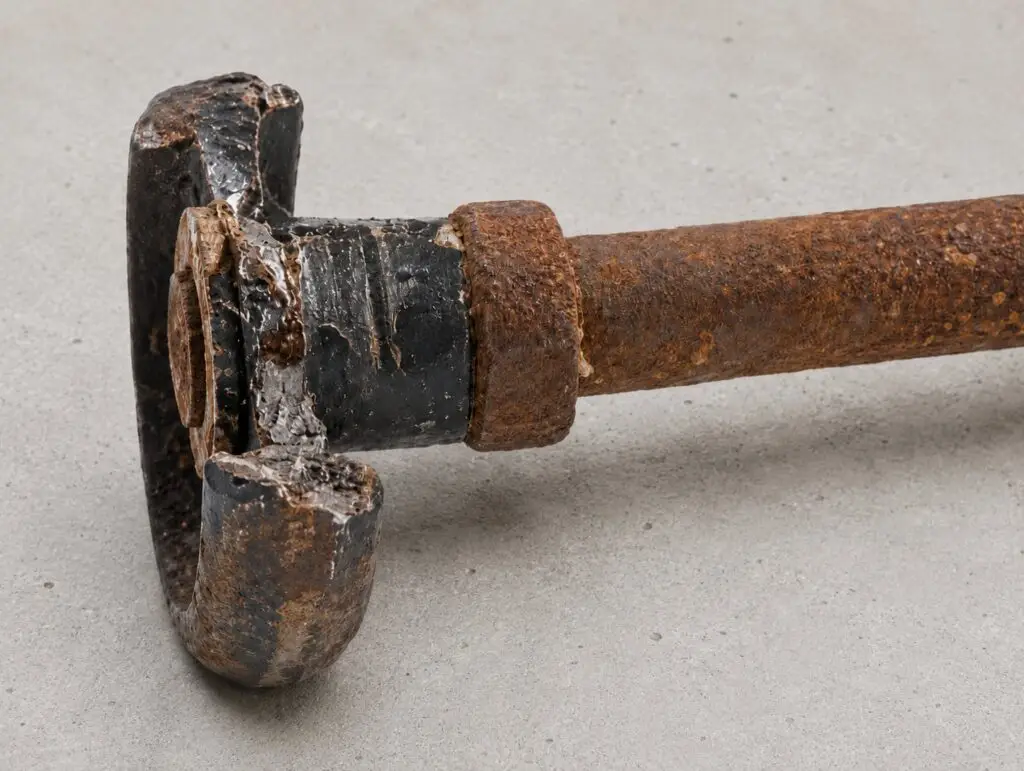
Repeated movement between the roller stem and hinge gradually wears both components.
Excessive play can reduce door stability.
Corrosion
Rust increases friction and accelerates wear.
Corroded bearings often become noisy before complete failure.
Impact Damage
Vehicles, tools, and accidental impacts can bend tracks or damage rollers.
Even minor track deformation may prevent rollers from moving smoothly.
Applications
Roller Selection by Application
Different environments place different demands on garage door hardware.
Selecting an appropriate roller depends on more than noise alone.
Application
Typical Roller Characteristics
Standard residential
Nylon or steel, ball bearing
Premium residential
High-quality nylon with sealed bearings
Heavy insulated doors
Heavy-duty ball bearing rollers
Commercial sectional doors
Steel rollers with hardened bearings
High-cycle facilities
Premium commercial high-cycle rollers
Humid or corrosive environments
Corrosion-resistant components where appropriate
The goal is to match the roller to the expected operating conditions rather than simply selecting the least expensive option.
Standards
Standards, Codes, and Industry Guidance
Garage door rollers are one component within a larger door system.
Their selection and installation may be influenced by several types of industry documents.
These include:
- Manufacturer installation instructions
- ANSI standards
- DASMA technical data sheets
- Building codes
- Product testing requirements
Each document serves a different purpose.
Manufacturer instructions explain proper installation.
ANSI standards establish voluntary consensus practices.
Building codes establish legally enforceable requirements where adopted.
Technical data sheets provide engineering guidance and industry recommendations.
Understanding the difference between these documents helps avoid confusion when researching garage door hardware.
Request service
Need Garage Door Roller Replacement?
Free estimates. No high-pressure sales. Call or request service and we’ll get back to you quickly.
No trip charge
No credit card fee
Inspection included

5.0 ★★★★★
47 Google reviews
Request Service
Tell us what’s going on and we’ll follow up to schedule.