
Resource Guide
Garage Door Cables
A complete guide to garage door cable assemblies, including wire rope construction, materials, cable sizing, lay direction, common failure modes, inspection, and replacement considerations.
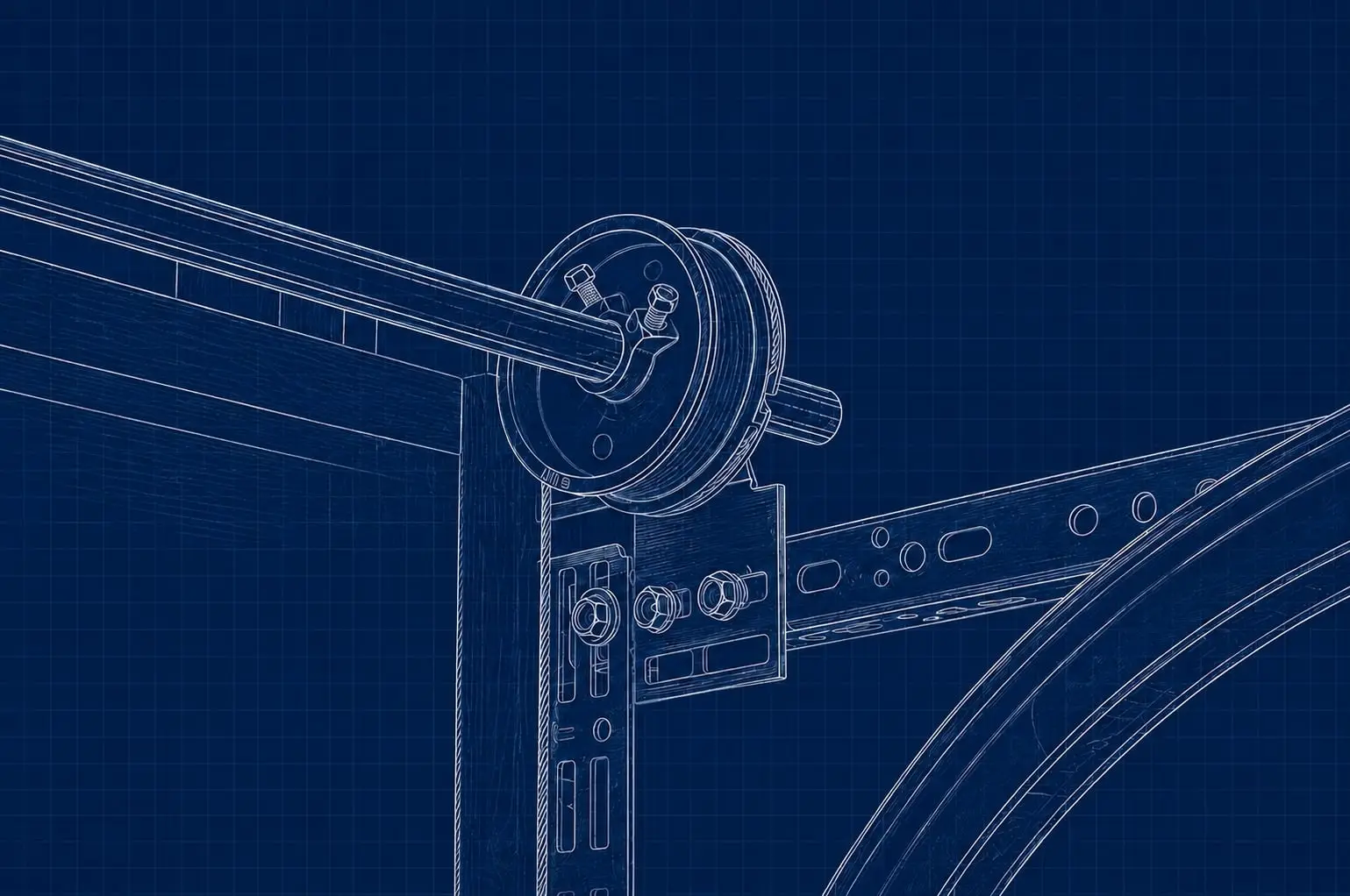
Frayed or loose cable?Leave the door closed. Call for cable replacement. Free estimates, no trip charge.
(612) 314-5990Cable Assembly
What is a Garage Door Cable Assembly?
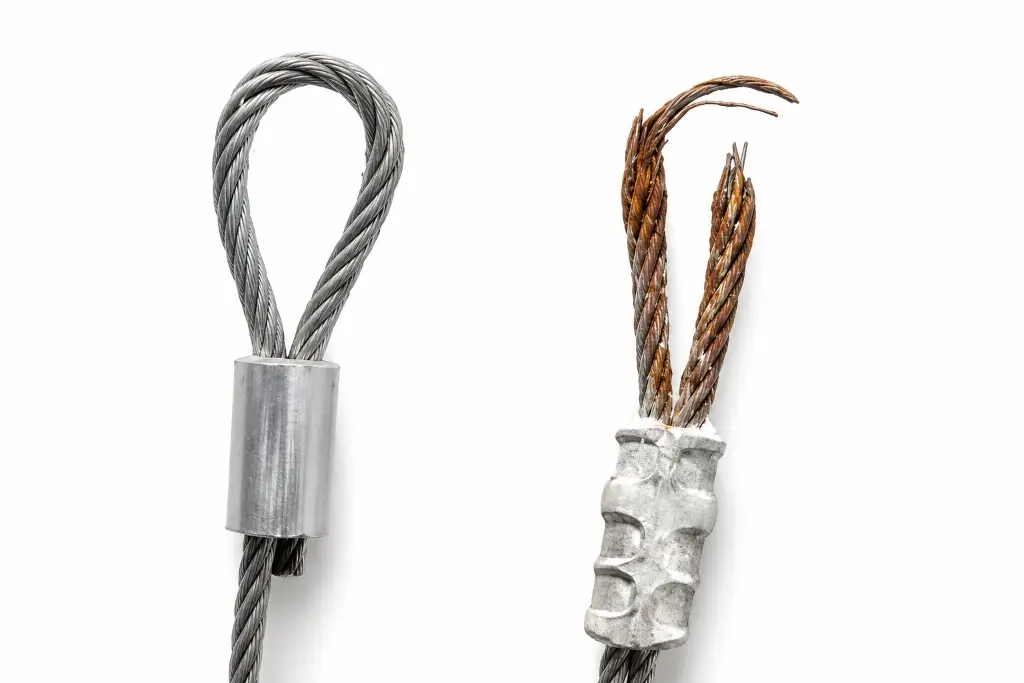
A garage door cable assembly is the connection between the garage door and the torsion spring system. As the springs unwind, the cable drums wind the lift cables to raise the door. When the door closes, the springs rewind and the cables unwind back onto the drums.
Most garage door cable assemblies consist of four primary components:
Wire ropeThe steel cable that supports and lifts the weight of the door.
Bottom loop or eyeConnects the cable to the bottom bracket attached to the door.
Ferrule or swageA metal sleeve permanently compressed around the cable to secure the loop.
Thimble (optional)A metal insert placed inside the loop to reduce wear. Thimbles are common on some commercial and industrial doors but are less common on residential systems.
Although the cable assembly appears simple, every component plays an important role. The wire rope provides the lifting strength, the swaged fitting transfers the load to the loop, and the entire assembly must withstand thousands of bending cycles while maintaining smooth, reliable operation.
Important Safety NoteGarage door cables operate under significant spring tension. A frayed cable or one that’s come off the drum is often a symptom of another problem within the door system. Continuing to operate the door can increase the damage or create an unsafe condition.
If you suspect a cable problem, leave the door closed if possible and have the entire system inspected before putting it back into service.
Wire Rope
How Wire Rope is Constructed
Wire rope is not a single solid wire. Instead, it is made from many individual steel wires twisted into strands. Those strands are then wound around a central core to form the finished rope.
7×7 Construction
7Strands
7Wires Per Strand
49Total Wires
7×19 Construction
7Strands
19Wires Per Strand
133Total Wires
Wire rope is identified by its construction. The first number indicates the number of strands, while the second indicates the number of individual wires in each strand.
A 7×7 cable contains 49 individual wires, creating a stiffer rope with good abrasion resistance. A 7×19 cable contains 133 individual wires, making it more flexible and better suited for repeated bending around garage door cable drums. That combination of flexibility and fatigue resistance makes 7×19 the preferred construction for most garage door lift cables.
Cable Sizes
Garage Door Cable Sizes
Garage door cables are available in several diameters. The correct size depends on the door’s weight, height, drum size, and overall system design. A larger cable is not always better. It must be matched to the application. Common cable sizes are 1/8-inch, 5/32-inch, 3/16-inch, and 1/4-inch.
- 1/8″
- 5/32″
- 3/16″
- 1/4″
ImportantCable diameter should never be selected by appearance alone. Using the wrong cable can affect how the cable wraps on the drum and how the door operates.
Common Cable Constructions
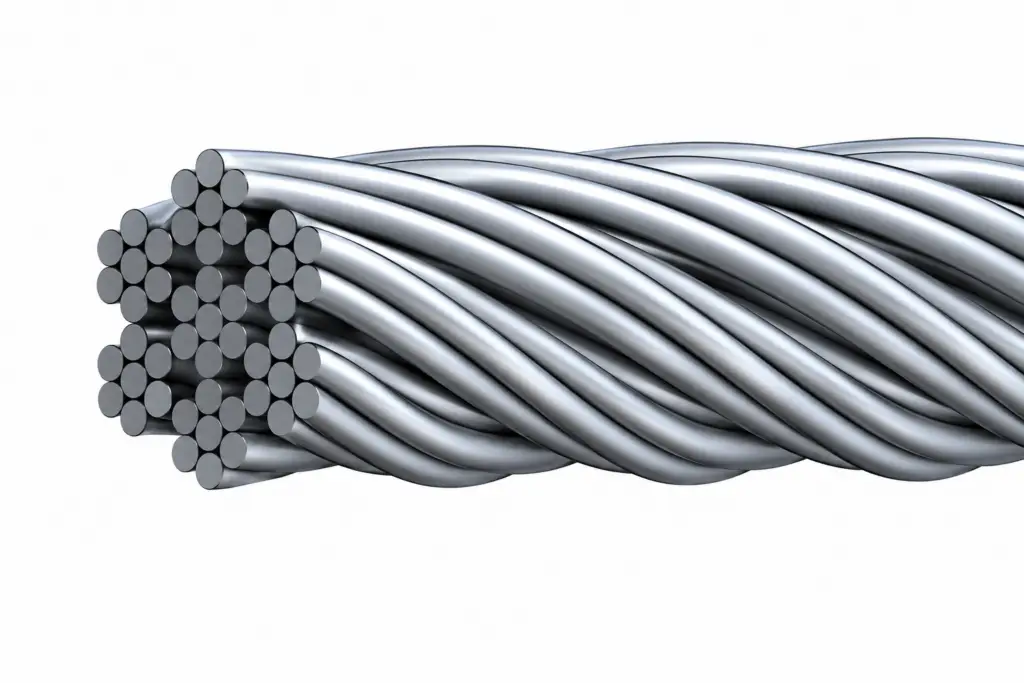
7×7 Wire Rope
- Stiffer construction
- Good abrasion resistance
- More economical
- Best for minimal repeated bending
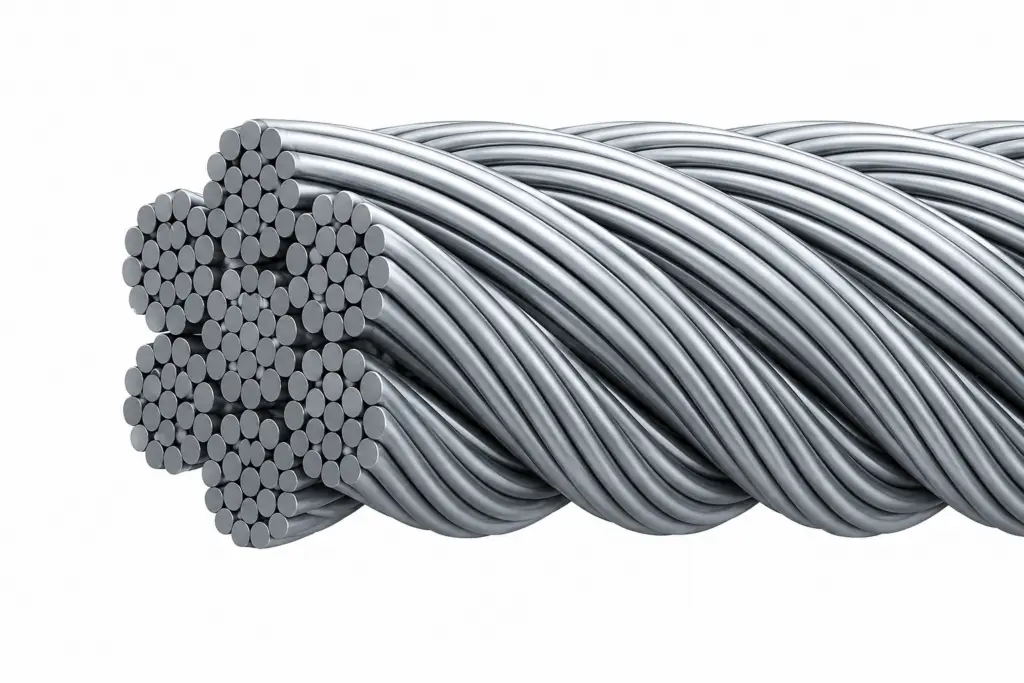
7×19 Wire Rope
- More flexible construction
- Excellent fatigue resistance
- Handles repeated bending well
- Preferred for most lift cables
Both 7×7 and 7×19 wire rope are used in garage door cable assemblies. While 7×7 is often chosen for its economy and abrasion resistance, 7×19 provides greater flexibility and fatigue resistance, making it the preferred choice where the cable repeatedly bends around drums or pulleys.
Wire Rope Lay
In addition to its construction, wire rope is manufactured with a specific lay. Lay describes the direction the individual wires and strands are twisted during production. Although it isn’t usually visible during normal operation, it affects how the rope performs in service.
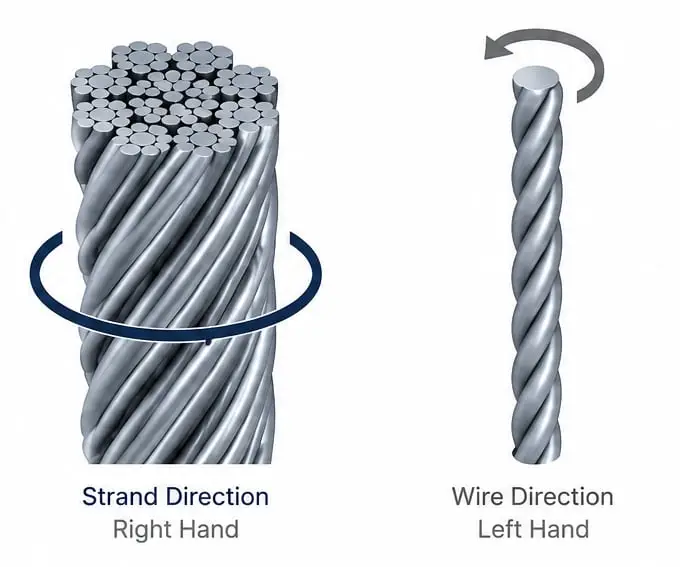
Regular Lay
Individual wires are twisted in the opposite direction of the strands.
Advantages
- Better abrasion resistance
- Less likely to untwist during handling
- Stable under normal operating conditions
Considerations
- Slightly less flexible than Lang lay
- Not intended for applications where maximum flexibility is the primary requirement
Typical UseMost garage door lift cables use regular lay construction.
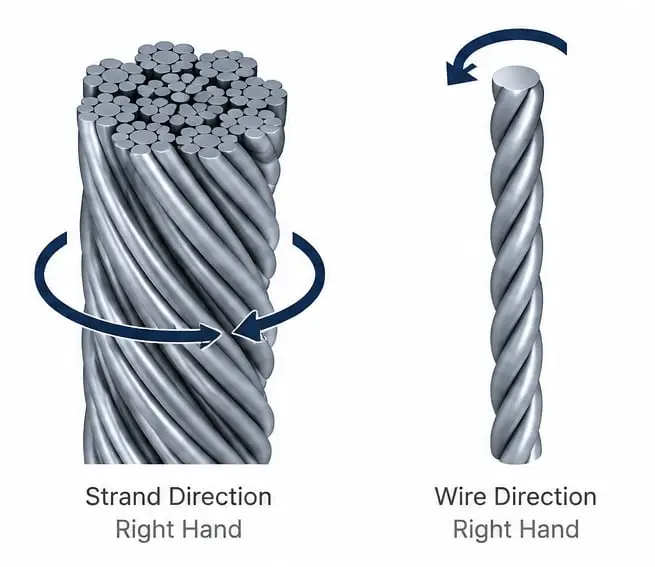
Lang Lay
Individual wires are twisted in the same direction as the strands.
Advantages
- Greater flexibility
- Excellent fatigue resistance in some applications
Considerations
- More prone to twisting and rotation
- Wears differently on drums and sheaves
Typical UseCommon on cranes, hoists, and other industrial equipment, but generally not used for garage door lift cables.
Why It MattersThe lay of a wire rope influences how it performs in service. Because garage door cables repeatedly wrap around relatively small cable drums, stability and predictable operation are more important than maximum flexibility. For that reason, most garage door cables are manufactured using regular lay galvanized wire rope.
Materials
Garage door lift cables are typically manufactured from either galvanized carbon steel or stainless steel. Galvanized steel is the industry standard for most applications, while stainless steel is reserved for environments where corrosion resistance is especially important.
Galvanized Steel
Galvanized steel cables are coated with zinc to help resist corrosion while maintaining excellent strength and flexibility. They provide a long service life at a reasonable cost, making them the preferred choice for most residential, commercial, and industrial garage door applications.
Stainless Steel
Stainless steel cables are commonly used in highly corrosive environments such as coastal areas, car washes, food processing facilities, wastewater plants, and chemical facilities.
While stainless steel offers excellent corrosion resistance, it generally costs more, has slightly lower tensile strength than galvanized steel, and may wear more quickly against cable drums. For most garage door applications, galvanized steel provides the best balance of durability, performance, and value.
Cable Failures
Why Garage Door Cables Fail
Garage door lift cables rarely fail from a single event. Instead, they gradually weaken from repeated bending, corrosion, wear, or problems elsewhere in the door system. Identifying the underlying cause is just as important as replacing the damaged cable.
Common causes include:
- Repeated bending around the cable drum during normal operation
- Rust or corrosion near the bottom loop or lower section of the cable
- Sharp edges on the cable drum or bottom bracket
- Incorrect cable length or mismatched cable drums
- An unlevel or improperly balanced door
- Uneven spring tension
- Damaged or worn bottom brackets
- Cables rubbing against the track, hardware, or door
Warning Signs
Warning Signs of Cable Trouble
Garage door lift cables rarely fail without warning. In many cases, they show visible signs of wear or create changes in the way the door operates long before a complete failure occurs.
Watch for these warning signs:
- Broken wires or visible fraying
- Rust, corrosion, or dark discoloration
- Flattened, kinked, or bird-caged sections
- A cable riding outside the drum grooves
- One side of the door sitting lower than the other
- A loose cable when the door is fully closed
- Popping, scraping, or rubbing sounds during operation
If you notice any of these conditions, have the entire garage door system inspected. Replacing a worn cable without identifying the underlying cause may only delay another failure.
Replace Both?
Should Both Cables Be Replaced?
Garage door cables should always be replaced as a matched pair. Both cables have completed the same number of lift cycles and have experienced the same wear, bending, and environmental exposure.
Cables also stretch slightly over time. Installing one new cable alongside an older cable can leave the two sides at different effective lengths. That difference can prevent the door from hanging level. On doors without an adjustable shaft coupler, there may be no practical way to compensate for the mismatch.
Replacing only the failed cable also leaves an equally worn cable on the opposite side, increasing the likelihood of another failure. Since most of the labor is already involved in replacing one cable, replacing both provides a safer, more reliable, and longer-lasting repair.
Request service
Need Garage Door Cable Repair?
Free estimates. No high-pressure sales. Call or request service and we’ll get back to you quickly.
No trip charge
No credit card fee
Inspection included

5.0 ★★★★★
47 Google reviews
Request Service
Tell us what’s going on and we’ll follow up to schedule.